
Smalley-Curl Institute
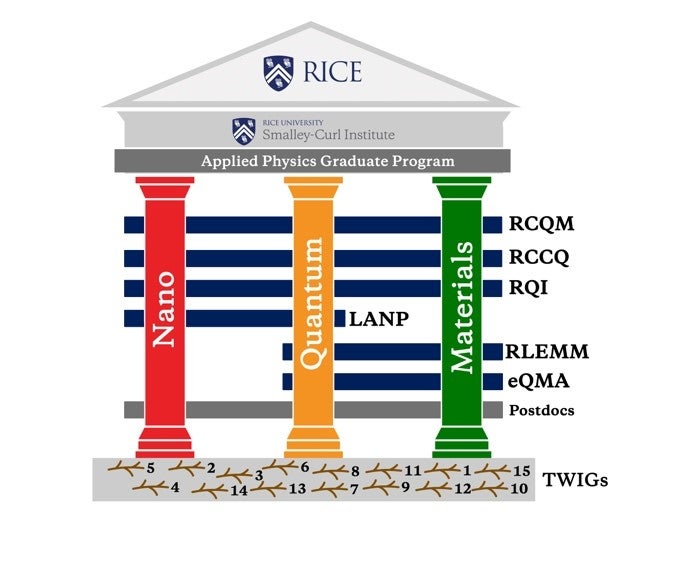
Named for Richard Smalley and Robert Curl, two of the three Nobel Prize winners for the 1985 discovery of C60—the buckminsterfullerene—the Smalley-Curl Institute (SCI) fosters a global community of research, scholarship, and education focused on three areas of primary interest: nanoscale, quantum, and materials.
The Institute arose from the 2015 merging of the Rice Quantum Institute (RQI), which was founded in 1979 and stands as the first institute established at Rice University, and the Smalley Institute, founded in 1993 by Dr. Smalley as the Center for Nanoscale Science and Technology and renamed the Smalley Institute in 2005 after Dr. Smalley’s death. Folding the RQI into the SCI added quantum research and the Applied Physics Graduate Program to the organization’s portfolio. To maintain emphasis on quantum research, Rice re-fashioned the RQI as the Rice Quantum Initiative, and placed it under the SCI umbrella.
The Applied Physics Graduate Program (APP) is integral to the Smalley-Curl Institute. The APP boasts more than 100 Ph.D. candidates, who it places with faculty across the Rice STEM constellation. In addition, the Institute’s postdoctoral program regularly supports from seven to nine top researchers who, with the students, are at the core of the Institute’s highly interactive and interdisciplinary community. The Institute and its centers provide frequent opportunities—with seminar series, colloquia, schools, and poster sessions—for members and visitors to engage in discussion and collaboration.
| Departments/Entities where APP students affiliate: | ||
|---|---|---|
| ECE MSNE MECH |
PHYA CHBE CS |
CHEM BIOE TMC |
With its culture, centers, initiatives, activities, and thematic working interest groups (TWIGs), the SCI helps set the standard for Rice institutes in generating a productive pipeline of grant proposals and talent. From FY23 to the present, SCI-driven proposals have brought in $12M in wins, worth about $2.8M in F&A to the University. The Institute continues to support large grant proposals. How this works:
- The SCI’s 15 TWIGS are self-assembled groups of faculty from across Rice who establish new topic areas and develop them toward applying for large center grants. TWIGs that win large grants “graduate” to become centers. So far, two have done so—with one becoming the Rice Center for Cavity Quantum Electrodynamics (RCCQ) and another becoming the Rice Laboratory for Emergent Magnetic Materials (RLEMM).
- SCI centers and initiatives focus on supporting broad subsets of work that are relevant to SCI members by holding seminars, colloquia, meetings, and poster sessions with both internal and external partners. The Institute regularly attracts research leaders from around the world to its events, which are held in Houston and the Rice Global location in Paris. In addition to RLEMM and RCCQ, the Institute includes the Rice Center for Quantum Materials (RCQM), the Rice Quantum Initiative (RQI), the LAboratory for NanoPhotonics (LANP), and the extreme Quantum Materials Alliance (eQMA).
- The SCI also brings academic visitors from around the world to Rice—from undergraduate exchange students to visiting graduate students and faculty. Institute leaders also travel regularly to connect with top researchers from Germany’s Max Planck Institutes, France’s network of leading research universities, and universities in Japan, Taiwan, Singapore, and India. This ensures that we continue to help define the future in our pillars of research.