
Welcome to our Analytical Elemental Characterization Service, where we provide comprehensive, high-quality chemical and elemental analysis to support research, development, and industrial innovation.
Our facility integrates advanced instrumentation and expert technical support to deliver accurate, reproducible, and efficient analytical solutions across a wide range of materials and sample types. Using Inductively Coupled Plasma Mass Spectrometry (ICP-MS) and Inductively Coupled Plasma Optical Emission Spectroscopy (ICP-OES), we offer sensitive trace and ultra-trace elemental quantification as well as major and minor elemental composition analysis. These capabilities support applications spanning environmental science, energy materials, catalysis, geochemistry, life sciences, and advanced manufacturing.
To ensure optimal sample preparation and data quality, our service includes microwave digestion, enabling reliable dissolution of complex matrices such as metals, ceramics, polymers, biological materials, and environmental samples. For bulk elemental composition, our Organic Elemental Analysis (OEA) provides precise carbon, hydrogen, nitrogen, sulfur, and oxygen quantification, while Combustion Ion Chromatography (C-IC) enables accurate determination of halogens and sulfur in challenging organic and inorganic matrices.
Our mission is to partner with researchers and industry users by providing not only analytical measurements, but also consultation, method development, and data interpretation support. Whether you require routine analysis, testing, or customized method development, our team is committed to delivering reliable results aligned with your scientific objectives.
We look forward to supporting your research and analytical needs.
Contact information:
Please contact Tanguy Terlier to request fee-for-service analysis or for more information about training.
Tanguy Terlier
Email: tanguy.terlier@rice.edu
Phone: 713-348-2251
Locations:
Ralph O’Connor building for Engineering & Science, Laboratory B12, Main Campus.
Training
Facility-supported training and supervised access sessions are offered during the following fixed time blocks:
- Mondays: 8:30 AM –1:00 PM
- Wednesdays: 8:30 AM –1:00 PM
- Thursdays: 8:30 AM –1:00 PM
- Fridays: 8:30 AM –1:00 PM
Access outside these periods may be granted only after successful completion of all required training and explicit approval from facility staff.
Please use the reservation calendar to book your training spot.
Fees & policies
- Research Facility User Account, Training, and Operational Policy
- Research Facility Analytical Service Policy & Pricing
Instruments
PerkinElmer Avio 550 ICP-OES:
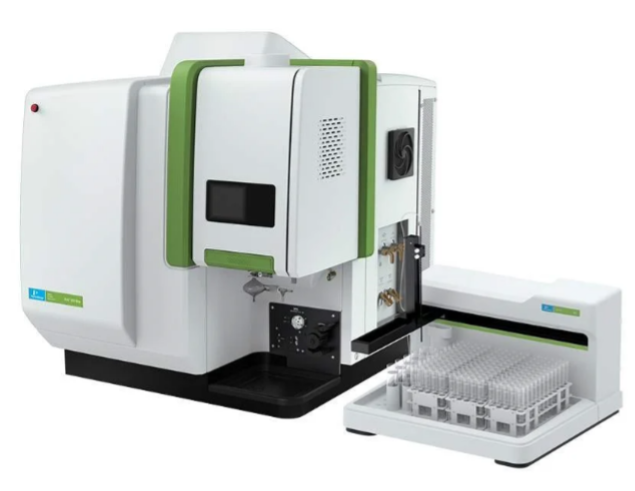
Inductively Coupled Plasma Optical Emission spectroscopy (ICP-OES) is an analytical technique used to determine how many certain elements are in a sample. The Avio 550 is a bench top ICP-OES with dual solid-state detectors that can perform trace elemental analysis. The Avio uses two SCD (Segmented-array Charge-coupled Device) detectors that cover a spectral range from 163 - 782 nm. The resolution of the system is specified to be 0.006 nm at 200 nm.
Our ICP systems are equipped with S23 Autosampler with three racks (up to 180 samples).
PerkinElmer NexION 2000 ICP-MS
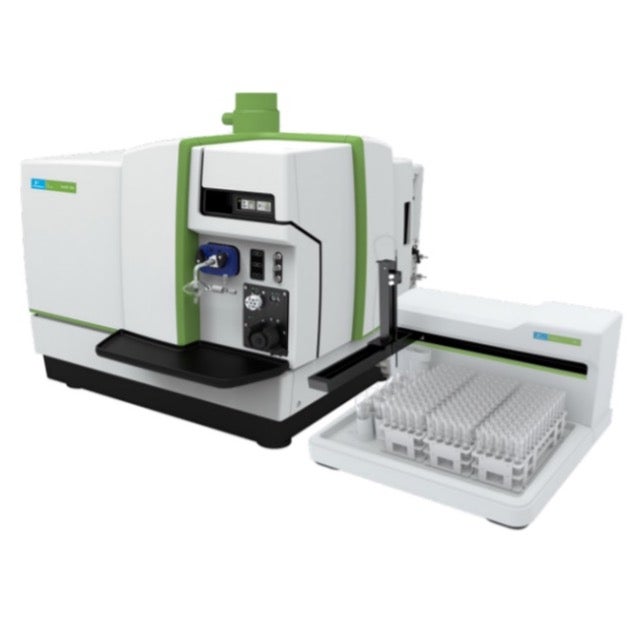
Inductively coupled plasma mass spectrometer (ICP-MS), is commonly used to measure the concentration of most elements for rapid, precise and accurate trace (<1000 ppm) determinations in liquid and solid samples (after an appropriate chemical digestion and filtrating). The principle of ICP-MS is to inject a liquid by creating an aerosol that is sampled into a plasma created using Argon and an RF field. Thus, the plasma creates a very high effective temperature, which atomizes and ionizes the sample. The ions are detected by a quadrupole mass spectrometer, which analyzes the ions by their m/z ratio.
NexION 2000 ICP-MS has two features to improve the results, by reducing interference. The first is a quadrupole ion deflector which only allows ions to enter the quadrupole while neutrals and photons are prevented by geometry from entering the quadrupole and impacting the detector. The second is the Universal Cell Technology™, that can operate in three modes (standard, collision, and reaction), which can either uses collisions of polyatomic interferences to reduce their kinetic energy, which are prevented from entering the quadrupole or can use different gases (NH3 or O2) to react with polyatomic interferences to change their mass or neutralize them. An additional feature of the NexION 2000 is a dual detector mode that allows for quantitation over a large dynamic range.
Our ICP systems are equipped with S23 Autosampler with three racks (up to 180 samples)
Perkin Elmer MPS320 Digestion system
The MPS 320™ Microwave Digestion system is a microwave digestion system for PerkinElmer’s ICP-OES, and ICP-MS instruments that accommodates a wide range of sample matrices and applications. It provides the choice of closed-vessel digestion, a requirement for working with volatile elements, which allows digestion to continue when preset pressure is reached.
XPREP Combustion Ion Chromatography (C-IC)
Automated Sample Preparation Solution for the Analysis of Total Fluorine, Chlorine, Bromine, and Iodine by Combustion Ion Chromatography Method. C-IC is used as a complementary screening technique to LC-MS/MS for the analysis of per- and polyfluoroalkyl substances (PFAS) by determining total adsorbable organic fluorine (AOF) as an indicator of the presence of fluorinated compounds. The common applications of this instrument are Environmental Monitoring (e.g. PFAS Monitoring), Petrochemicals, (Bio)Fuels, Lubricants, Organic Solvents & Chemicals, Polymers (raw materials and final products).
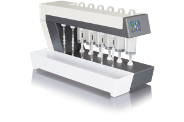
Additionally, the instrument offers an accessory, the Xprep-A6. This is a standard in AOX and AOF analysis, providing laboratories with the flexibility to adapt to industry demands. Whether for traditional AOX applications or pioneering AOF analyses, the Xprep-A6 delivers precision, durability, and cost-effectiveness to absorb the AOX and AOF content in an activated carbon cartridge
Costech Elemental Combustion System
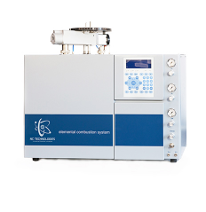
Costech Nitrogen/Protein Analyzer; Model 4010 is designed for advanced CHNOS analysis and nitrogen/protein determination. Equipped with two furnaces; a combustion furnace is up to 1100°C and the reduction furnace temperature of 650°C. The combustion gases are separated by gas chromatography for CHNOS analysis. The elemental analysis technique is based on “flash combustion” / chromatographic separation. CO2, H2O, SO2 and N2 or O2, are separated in a GC column kept at a constant temperature for Carbon, Hydrogen, Nitrogen, Sulfur and Oxygen determination.
Thermo Scientific Flash Smart
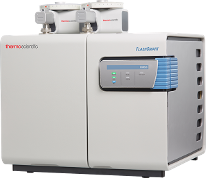
Thermo Flash Smart Organic Elemental Analyzer is a modern and compact analyzer designed for unattended and fully automated operation in Nitrogen through CHNS/O modes in any type of sample. The ability to switch from CHN or CHNS to Oxygen without powering down to reconfigure, excellent accuracy and reproducibility and ease of use are the most visible results of the technological innovations packaged into this analyzer.
Sample submission page
To submit samples to the lab, please contact Tanguy Terlier (tanguy.terlier@rice.edu) for instructions and to discuss your project.
Please the following Application form for submitting your samples
Policy & pricing for the analytical service can be found in the fee & policy page.