
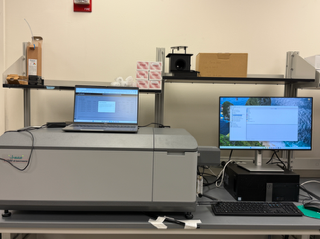
JASCO J-1500 Circular Dichroism Spectrophotometer
LOCATION
BRC 320D
PRICING
Rice User Fee: $5/hr for short runs, $3/hr for 12+ hr runs
Non-Profit Fee: $7.85/hr
For Profit Fee: $25/hr
Rice Training Fee: $10/hr
Non-Profit Training Fee: $15.70/hr
For Profit Training Fee: $50/hr
CONTACTS
Training Contact:
Lihua Ma, Ph.D
lm86@rice.edu
DESCRIPTION
The JASCO J-1500 is a high-performance circular dichroism (CD) spectrophotometer, an optical spectroscopy instrument that measures the differential absorption of left- and right-circularly polarized light by chiral molecules. CD measurements are critical in structural biology, biochemistry, materials science, and organic chemistry for understanding molecular structure, conformations, and folding/unfolding dynamics. This technique is particularly valuable for analyzing macromolecules such as proteins, peptides and nucleic acids, providing insights into secondary and tertiary structures — including α-helices, β-sheets, turns, and random coils — without the need for labeling or extensive sample preparation. The JASCO J-1500 CD/LD/Absorbance/Fluorescence Spectropolarimeter uniquely enables simultaneous measurement of CD, LD, Absorbance, and Fluorescence, allowing detection of artifacts such as birefringence while delivering high-quality data. Its patented optical system, featuring dual monochromators with prism polarizers and a collimated beam, maximizes light throughput, minimizes stray light (<0.0003% at 200 nm), and permits precise measurements with very short pathlength cells. The system supports continuous, step-scan, and auto-scan modes for rapid, sensitive acquisition, even for photolabile samples. Temperature control from -10 to 110 °C, with continuous or stepped ramping, enables 3D data collection (Wavelength vs Temperature vs CD/LD/Absorbance/Fluorescence), and the six-position Peltier allows automated measurements of multiple samples including parallel thermal ramps. Micro-sampling permits CD and Absorbance measurements on volumes as small as 2 µL or 10 µL, while Fluorescence and LD use standard sample volumes of 200 µL and 2 mL. Mechanical shutters protect samples from photobleaching, and integrated Mercury lamp and NH4CSA standards ensure fully traceable calibration.