
1. What is an MOU?
Rice University researchers establish a Memorandum of Understanding (MOU) when conducting collaborative research involving live vertebrate animals with external institutions.
According to the Guide for the Care and Use of Laboratory Animals, institutions involved in offsite animal activities should have a formal agreement—such as an MOU—that outlines responsibility for animal care, ownership, and IACUC oversight (p.15).
To support compliance and reduce administrative burden, the Rice IACUC provides an MOU template that can be accessed by clicking here. This template promotes proper oversight, clarifies institutional responsibilities, and prevents concerns that could negatively impact research animals during collaborative projects.
2. Who does this apply to?
This information is for Rice University researchers involved in collaborative studies with external institutions that use live vertebrate animals. It applies especially when animals are housed, cared for, or used at locations outside of Rice.
3. When is an MOU needed?
An MOU should be completed when:
- Rice is not conducting animal research and is not responsible for care, housing, and oversight. However, the collaborating institution will be the performance site responsible for animal research.
- Rice will conduct some live animal work outside the institution.
- Rice funds are used to support animal work conducted at a non-Rice facility. (e.g., A subcontractor conducts procedures involving animals at his institution funded by a Rice grant.)
- Rice is engaged in animal activity at an off-site location.
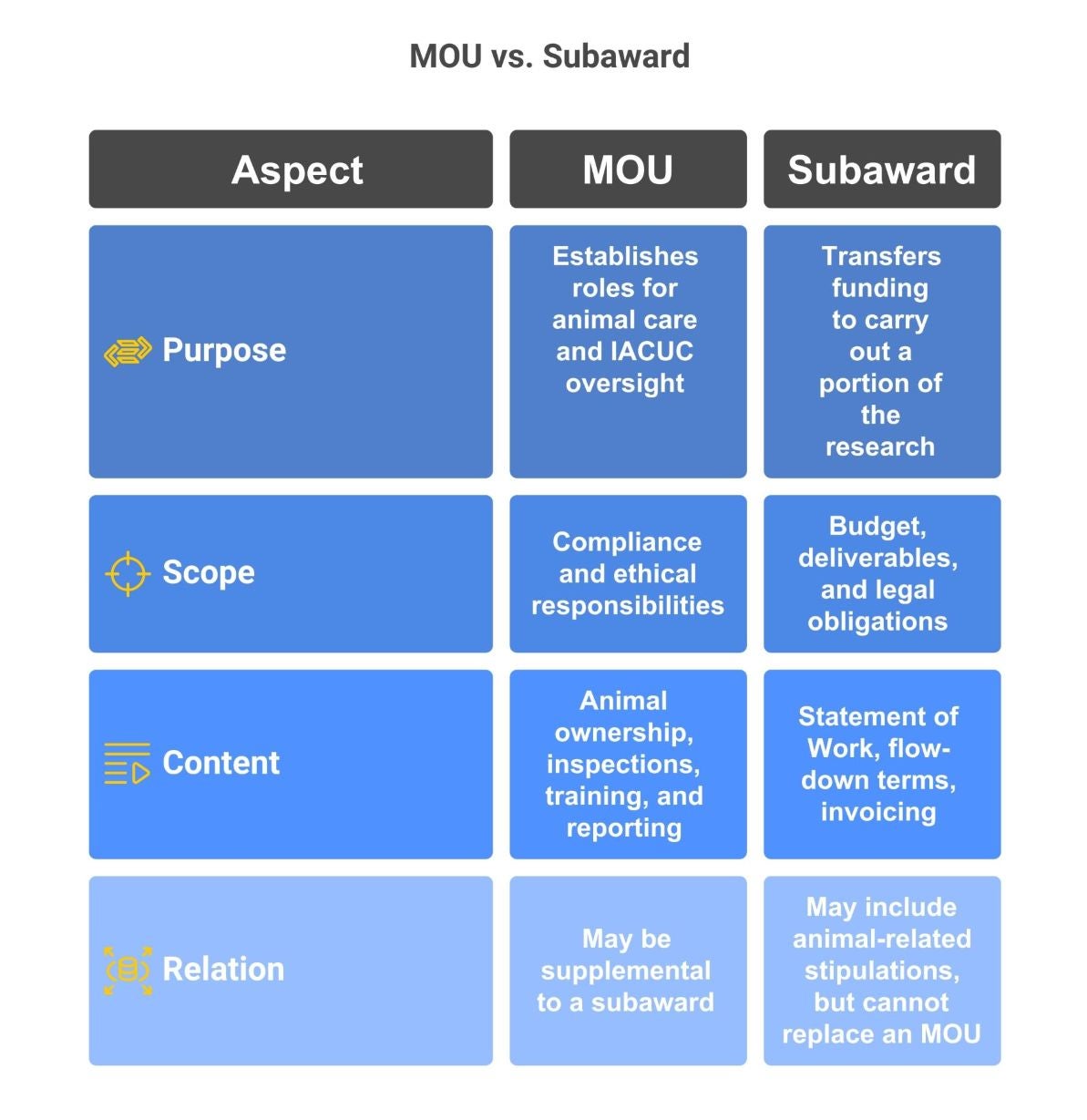
4. What are the differences between an MOU and a subaward?
5. What should an MOU include?
Based on the FDP and OLAW IACUC MOU and Rice University requirements, an MOU should address:
- Institution’s oversight agency information (USDA registration, PHS Assurance, OLAW /AAALAC accreditation).
- Clear designation of animal ownership and transfer logistics.
- Roles and responsibilities for the care and use of animals.
- Transportation responsibilities, if applicable.
- Oversight responsibilities and IACUC review requirements.
- Notification requirements for inspections, adverse events, and non-compliance.
- Documentation and record retention responsibilities.
- Procedures for protocol amendments and triennial reviews.
6. What is Inter-institutional Assurance (IIA)?
An Inter-institutional Assurance (IIA) is a special Animal Welfare Assurance issued by the Office of Laboratory Animal Welfare (OLAW) under the Public Health Service (PHS) Policy on Humane Care and Use of Laboratory Animals. Federal law (the Health Research Extension Act of 1985) empowered NIH to require institutional assurances for animal research. Accordingly, PHS Policy mandates that any U.S. institution receiving PHS funding have an OLAW-approved Assurance before engaging in animal activities. An IIA is required when the institution receiving funding does not have its own animal program or Institutional Animal Care and Use Committee (IACUC) and plans to conduct animal research at another assured institution. In other words, if the animal research funded by the grant will be carried out entirely at a facility with its own Assurance, the awardee must establish an IIA with the Office of Laboratory Animal Welfare (OLAW).
For additional details please visit: https://olaw.nih.gov/resources/documents/interinstitutional-assurance.htm
7. What are researchers' responsibilities in collaborative animal research?
Faculty, students, and staff (researchers) involved in collaborations should:
- Work with the Rice PI to initiate the MOU process.
- Complete required training through the AALAS Learning Library courses. For guidance please refer to the attached AALAS How-To Guide for Accessing the AALAS Learning Library courses.
- Submit an animal protocol to the institution's IACUC for review and approval, and an approval letter must be received before initiating any animal experiments. Consult with the Attending Veterinarian for questions regarding protocol design and the IACUC office for submission processes.
- Ensure all personnel handling live animals are adequately trained and maintain Research Personnel Training Records.
- For off-site research, ensure a proper MOU is established between institutions.
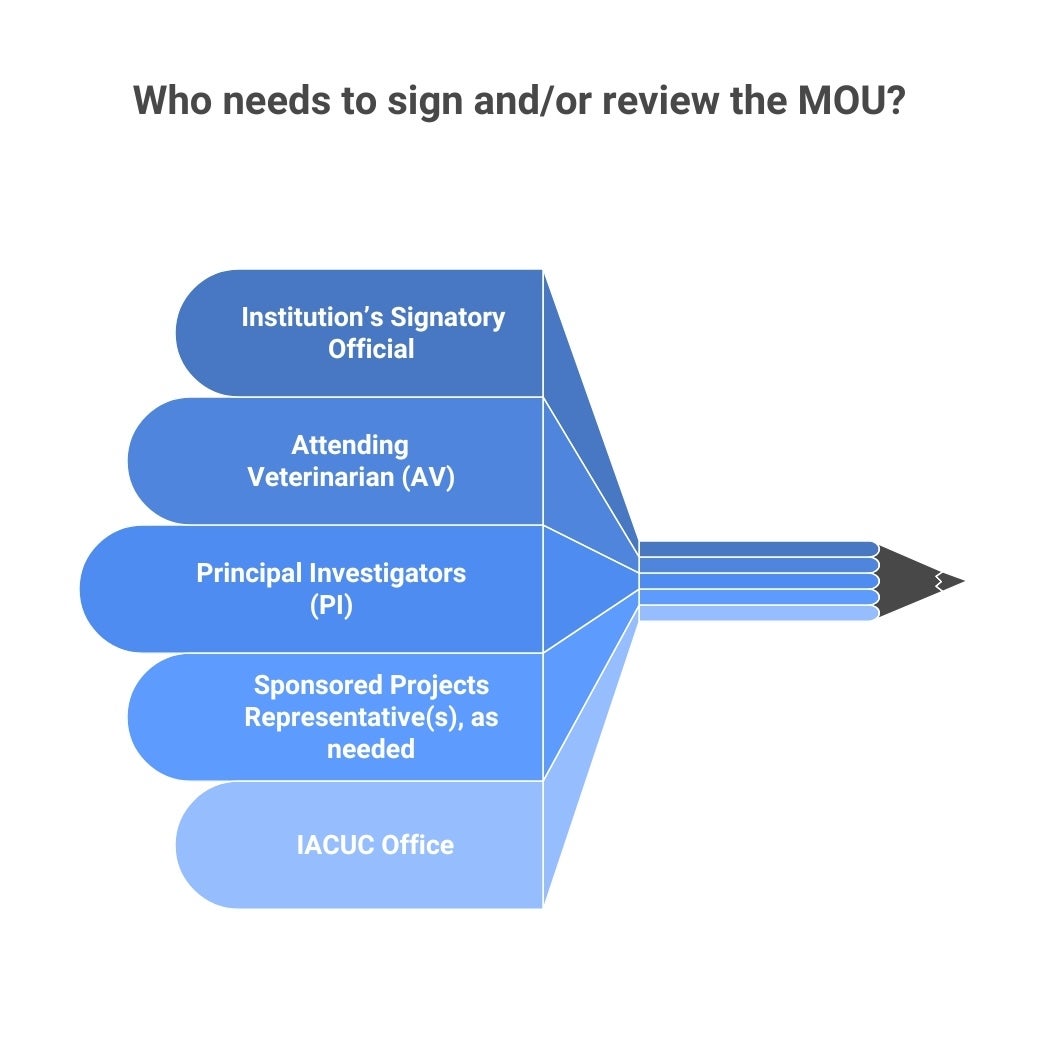
8. Who needs to sign the MOU? Who reviews it?
9. How are MOUs distributed and maintained for recordkeeping?
- Email the finalized MOU to the Rice IACUC office at iacuc@rice.edu.
- The Rice IACUC office will distribute the fully executed MOU to the collaborating institutions' contacts and researchers.
- The PI should maintain the MOU as part of the research records.
- Keep the MOU available for review during inspections by regulatory agencies or accrediting bodies.
- Update the MOU if the scope of work, housing location, or PI changes.
MOU FAQ
- 1. Why do we need an MOU?
-
An MOU ensures clarity of roles and regulatory compliance in collaborative research. This helps to provide an explicit declaration and understanding between institutions about who is responsible for each of the normal IACUC requirements to ensure that none of these requirements are accidentally neglected. This protects animals, researchers, and institutions from non-compliance.
- 2. Can a subaward replace an MOU?
-
No. While a subaward organizes and establishes funding and may include some animal-related stipulations, it does not define detailed IACUC oversight or animal welfare responsibilities that are required by federal funding agencies and Rice policies. This is the role of the MOU - to fulfill these functions.
- 3. When should I start the MOU process?
-
Like most inter-institutional arrangements, MOUs can take some time for negotiation and agreement. This process should be initiated as early as possible during planning of animal research. For federal grants requiring an Inter-Institutional Agreement (IIA), plan for this process to take at least 1 week (5 business days) for processing.
- 4. What if the other institution has already approved the protocol?
-
An MOU is still needed to establish which institution has primary oversight responsibility and to clarify roles and responsibilities.
- 5. What happens in the event of non-compliance?
-
All of the collaborating institutions should communicate and cooperate in the investigation of any concerns about animal welfare that are reported. One institution will be designated as the lead, but all institutions should cooperate with that leading institution.
- 6. Can an MOU be amended later?
-
Yes. If the scope, facilities, or personnel related to the research change, the MOU should be updated. Some other scenarios requiring modification include grant termination, changes to location of animal housing, changes in PI, or substantive changes in the scope of work.
- 7. Does the Rice IACUC need to review protocols approved by another institution's IACUC?
-
Typically, no, unless Rice retains oversight of the animal work. If Rice relies on another IACUC for oversight, this must be formalized through an MOU or an Inter-Institutional Assurance (IIA), depending on requirements from the funding agencies and other regulatory requirements.
Contact Information:
Rice University IACUC Office Email: iacuc@rice.edu