
BY KATHARINE SHILCUTT
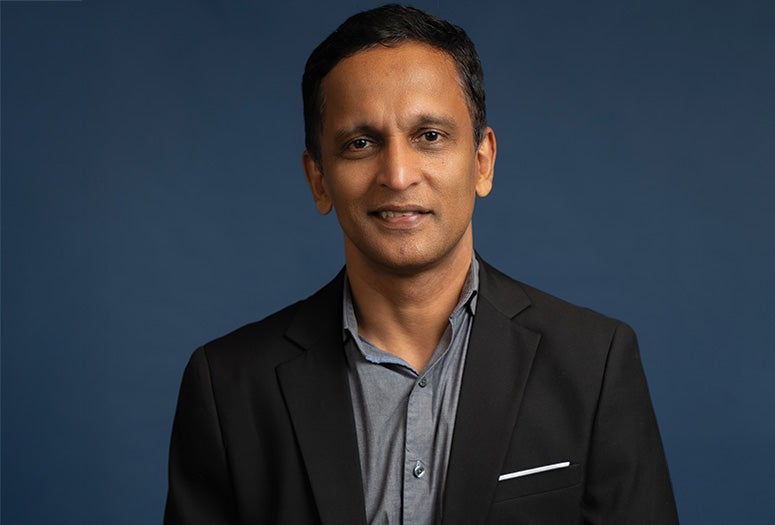
Vinod Veedu, assistant vice president in Rice’s Office of Research, leads the Office of National Security Partnerships, Rice’s emerging “critical interface” with government agencies, driving the university’s shift from transactional defense grants to long-term national security partnerships

You spent almost 18 years in industry before coming to Rice. What brought you here?
I had what many would call a dream job, working in the defense and energy industries that I absolutely love. It was a high-octane leadership role, with constant domestic and international travel, building new businesses and deploying major technologies. Over time, I realized I wanted to recalibrate my pace to be more present for my teenage kids while continuing meaningful work in national security. The timing was perfect: Rice approached me about leading the National Security Research Accelerator. What truly drew me in was their conviction: Rice was serious about national security work and had bold ambitions, offering a tremendous opportunity to build something significant and enduring around the university’s core technological strengths.
People are sometimes surprised that Rice does defense work. How do you answer that?
For decades, Rice has engaged in defense work, specializing in fundamental research that drives disruption. A powerful example is the work of Richard Smalley, where crucial early defense investment catalyzed the Nobel Prize-winning discovery that eventually spawned a global nanotechnology industry valued at hundreds of billions of dollars (see “The Once and Future Home of Nanotech,” pg. 68). Our strength lies in creating entirely new fields and defining new vectors of possibility, not merely making incremental advances. While we recognize we are not currently designated as a University Affiliated Research Center, which are natural destinations for defense work, we possess exceptionally deep intellectual resources that enable this level of breakthrough innovation.
What kinds of projects show how national security needs shape Rice research today?
Rice research directly targets the “bleeding edge” needs in this space. A few quick examples that come to my mind: we’re doing groundbreaking work that’s reshaping the future of wireless connectivity by developing curved beams to eliminate line-of-sight issues and guarantee clear connections. In materials science, we use AI and rapid computation to strategically find breakthrough materials, replacing years of slow discovery with data-driven results. Our work also includes forging synthetic diamond for next-gen defense electronics, alongside projects in human-machine teaming, quantum, microelectronics and synthetic biology, positioning Rice to solve the DoD’s most demanding technology challenges.
What will success look like for you in the next five to 10 years?
Success will be defined by its ability to become the premier, nontraditional national security partner. This success hinges on three critical outcomes: first, securing serious, sustained funding that ensures long-term commitment and momentum in our research programs; second, establishing a secure national security research environment and infrastructure; and third, building active, integrated partnerships with key DoD labs and industry partners. Achieving these goals in at least three or four of our 10 identified core competency areas will confirm Rice’s status as a consistently trusted and high-impact contributor to national security needs.