

BY SCOTT PETT
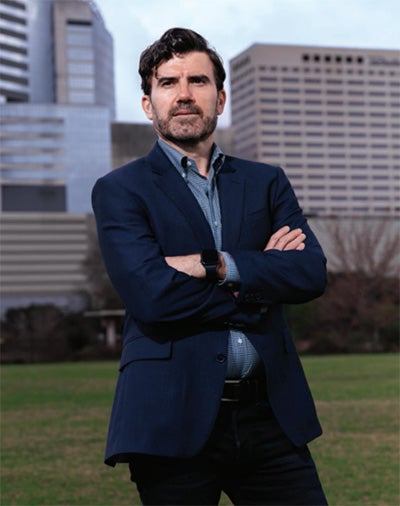
Tolga Tezcan explores innovative ways of designing and managing health care delivery systems and has collaborated with customer contact centers and hospitals to address issues relating to access. Tezcan currently teaches courses on operations management, business analytics and data mining at Rice’s Jones School of Business.
Your research mainly focuses on healthcare payment systems and insurance. Can you talk about the history of our national payment systems? How did they come about?
If you look at the early 1900s — when people paid mostly out of pocket — healthcare costs averaged maybe $150 to $200 per year in today’s dollars. Our procedures were not very complicated. And people didn’t live as long as they do today. Doctors would come to your home. They’d probably give you an aspirin or some kind of antibiotic, and that’s the most they could do.
That changed as technology advanced, but our payment system stayed the same until World War II. When people came back from the war, it became clear that a lot of older people could no longer pay for their healthcare. Private insurance came in and then Medicare and Medicaid in the 1960s. These systems had no incentive to be efficient.
Imagine taking your car to a mechanic and saying, “Fix everything.” What kind of bill is that mechanic going to come up with? That went on until the 1980s when healthcare became more transactional, and costs exploded.
I think we are moving toward a “capitation” payment system. In this system, like what Medicare Advantage does, healthcare institutions will receive a fixed amount, and they’re responsible for everything that relates to an episode of care. Now they have all the incentives to keep me healthy. They’re going to encourage me to exercise, not to drink, and so on and so forth.
Can you share an example of how operational research can make a real difference in healthcare?
When I was at the University of Rochester, we were looking at the causes of lengthy treatment times in the emergency room. We had to dig deep into their database to figure out where patients are spending time. From there, we used somewhat standard management tools to understand where the bottlenecks are, and then we’d try to find ways to decrease the hospital’s load.
Emergency rooms, unfortunately nowadays, are anything but emergent unless you’re dying. Otherwise, you register, and go through triage. The level of triage you fall in kind of determines your priority in the waiting line.

As researchers, we said, “Look: there are so many triage patients coming into the emergency room who could have gone to a primary care physician or to urgent care. Why don’t we start treatment in triage?” Let’s say you walk in with arm pain. Why don’t we just order an X-ray before you see a doctor? By the time the doctor sees you, the X-rays will be ready — because in the ER, doctors and beds are the bottleneck. Not X-rays. Our job as researchers is to help healthcare professionals identify these opportunities.
Much of what you’re saying is specific to the U.S. But I’m sure you have a very transnational perspective. You’re a native of Turkiye. You’re speaking with me from London.
Whatever you see in America — it’s one system. And there are other ways of doing this. Take the U.K. Until WWII, their system was very similar to the U.S. Obviously, they were more directly impacted by the war. And after the war, they nationalized all the hospitals by running them through “trusts” (i.e., nonprofit organizations). That way, the government can pay hospitals and keep track of quality issues.
There are similarities and differences wherever you go. The U.S. needs to get rid of prices. If Hospital A does a surgery and Hospital B does the same surgery, they should get paid the same amount regardless. Where they should be competing is on quality. If Hospital A ends up with better surgery outcomes, they should get additional money. And Hospital B should lose some of theirs.
The problem in the U.S. is that every insurance company goes around and negotiates with all these hospitals about how they’re going to charge for every single operation. Compared to the U.K. system, that’s the biggest difference. And that’s where we see the biggest inefficiencies in U.S. healthcare.
Is there anything else you'd like people to know about your research?
First, healthcare is not just about health. Healthcare is the economy. Healthcare keeps everybody healthy so that they can work and contribute. So, when you don’t provide health insurance for people, the whole economy suffers, not just that person’s life.
Even more, if you’re not changing jobs — a job you hate — because you don’t want to lose your health insurance, then you’re not doing a job where you’ll probably be more productive and contribute more to the overall economy. Healthcare is basically the backbone of the economy. So, whenever I hear people say they oppose universal healthcare, I can’t really fathom what they’re missing.
Second, in terms of research and my personal experience, healthcare operations has been a great field to research. With all due respect to people who research the supply chain, Amazon has billions of dollars to fund research. That’s not the case in healthcare. Healthcare needs people who have the flexibility and training to look at systems and ask systematic questions. It’s a great area of focus for universities and scholars.