
BY KATHARINE SHILCUTT
On stage, nothing ever turns out exactly the same way twice. For composer Anthony Brandt, that uncertainty is the point of “Free Rein,” a performance that blends live music, contemporary dance and neuroscience into something closer to a living experiment than a conventional concert.
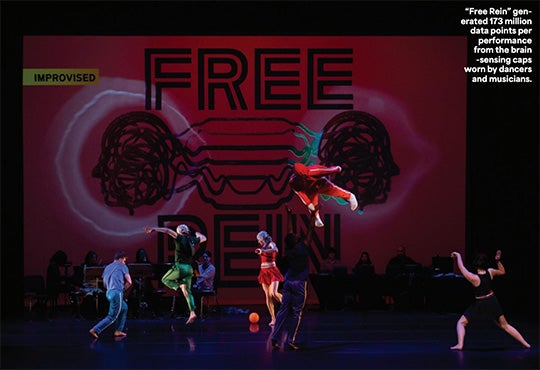
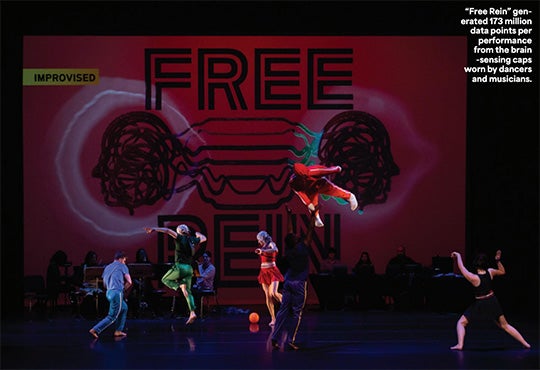
When the piece was staged earlier this year at Houston’s Hobby Center for the Performing Arts and MATCH, audience members watched dancers and musicians move between passages that were fully scripted and others that were improvised in real time, guided by rules but not outcomes. Both dancers and musicians wore brain-sensing caps, generating an enormous stream of data as the work progressed — 173 million data points per performance, to be exact. It’s data that neuroscientists will be able to mine for years to come as they try to decipher how exactly the brain functions when it’s creating on the fly.
“What’s happening in the brain when you’re doing something scripted versus improvising? That’s a crucial question in understanding how our minds work,” said Brandt, whose research at the intersection of music, performance and neuroscience has long probed such questions.
The caps his performers wear also generate visualizations for the audience, thanks to the work of Shepherd School doctoral candidate Badie Khaleghian, who are able to literally see a neuroscience experiment taking place in real time, far outside of the traditional boundaries of a lab or other such sterile research facility.
Such off-campus experiments are central to Brandt’s work at Rice’s Shepherd School of Music, where “Free Rein” acts as a vivid example of the kind of interdisciplinary research housed under the school’s new Music, Mind and Body Lab. The lab brings together composers, performers, dancers and neuroscientists to study how the brain behaves during real artistic activity. Too much research on creativity and the brain, said Brandt, has relied on tightly controlled lab environments that bear little resemblance to how creativity actually functions in the world.
“I feel like one of our jobs on the art side is to let music be itself in its full glory and be the wild menagerie of beasts that it is, so that we can show what’s happening in the brain when it’s actually behaving out in the real world,” Brandt said.
It’s a very rare real-world study of creativity.
“Free Rein” was designed to create those conditions. Structurally, the piece alternates between paired movements: one carefully composed, the other partially open, asking performers to invent their parts within specific constraints. “The scripted passages function as the scientific ‘control’,” Brandt said, ”so fixed and improvised sections need to occur in equal amounts.”
The form itself plays with audience expectations. Some movements introduce a fixed version before its improvised counterpart; others reverse that order, letting the improvised material come first and only later revealing the composed structure behind it. The final completely scripted movement, Brandt said, becomes “kind of the emotional core of the piece,” as a long stretch of improvisation suddenly crystallizes into something fixed.
Near the end of “Free Rein,” the score briefly disappears altogether. “The final movement alternates between fixed and free sections. Eventually, it ends up in a place where the score is blank,” he said. “The music and dance are free for about 70 seconds. What happens there is entirely in the hands of the performers.”
Freedom, however, does not mean chaos. One of the project’s central insights — shared by artists and scientists alike — is that improvisation depends on rules, vocabularies and shared expectations. Early rehearsals made that clear. “Honestly, the initial musical rehearsals sounded like everyone was in their own world,” Brandt recalled of the first attempt. Without collective intention, the music wasn’t expressive; it was arbitrary.
Improvisation, he came to see, functions more like conversation. “I don’t know exactly what you’re going to say, but I have to know what the words are,” he said. “My goal as a player is not to throw off the other musicians or to shock them. It’s to talk in the lingo we’ve developed among each other.”
That realization shaped both the artistic structure and the research design. Musicians improvised within defined pitch fields so they would remain harmonically connected to pre-recorded material. Dancers followed game-like rules — staying tethered by a bungee cord, keeping an object in contact with a partner’s body — that forced constant adjustment without devolving into randomness.
Those choices are exactly what make the project valuable to neuroscientists, including collaborators Andrew Nordin at the University of Houston and Anna Abraham at the University of Georgia. Across multiple performances and rehearsals, performers generated an unprecedented volume of neural data while engaging in authentic creative behavior. “It’s a very rare real-world study of creativity,” Brandt said.
Creativity, Brandt argues, is deeply tied to how people navigate uncertainty in everyday life. “Every time we have to adjust on the fly” he said, “we’re switching from a predictable model of the world into one where we improvise.”