
BY KATHARINE SHILCUTT
Over 40 years ago, in the fall of 1985, at a lab at Rice, a group of scientists had a far-out idea. What if they pointed a giant laser — basically a light cannon — at a chunk of pencil lead? What if this could tell them what happened to carbon atoms when they were blasted apart the way they might be inside a star?
Richard Smalley, a Rice professor of chemistry and physics, and his lab team had custom-built a laser-supersonic cluster beam apparatus that could vaporize graphite under conditions meant to mimic stellar environments. Fellow Rice chemistry professor Robert Curl ’54 and visiting chemistry professor Harold Kroto from the University of Sussex stood by with bated breath as Smalley’s team fired the laser.
Boom! The graphite exploded into a tiny cloud of hot, lonely carbon atoms. And inside the machine two very unexpected things happened: First, the cloud of graphite cooled so fast it was like someone opened a freezer door the size of a universe. What came next would ultimately win Smalley, Curl and Kroto the Nobel Prize in chemistry and launch the worlds of nanoscience and nanotech we know today.
Instead of the graphite cloud falling into a messy pile of soot — which is what carbon normally does — the atoms started snapping together in this ultra-cold environment. They didn’t snap into lines, or sheets or lumps. They snapped into balls. Perfect, tiny soccer balls made of exactly 60 atoms each.
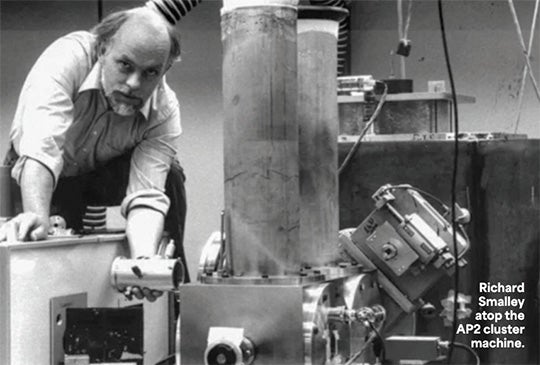
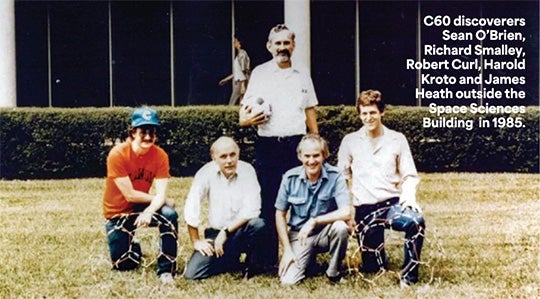
This whole experiment had come about because Harry (later, Sir Harold) Kroto had wanted to study carbon-based space dust in Rick’s device, which was one of only two in the world that could generate molecular clusters in a simulated space environment. (Rick and his group had also built the other identical device, which was being used at an Exxon lab.) It was while the group – Kroto, Smalley, Curl and grad students Jim Heath and Sean O’Brien – was studying space dust that the students noticed something weird. Where the time-of-flight spectroscopy they were conducting should have shown an even distribution of cluster sizes, there was an unexpected production peak at 60 carbon atoms. The students pointed this out to the professors, and they all realized that this anomaly was much more important than space dust: after tuning their laser further, with the help of colleagues Prof. Frank Tittel and student Yuan Liu, they could see clearly that the experiment produced a LOT more 60-atom particles than would have made sense, if they were just clusters. With that many 60-atom particles being created and surviving, the team decided that they must be true molecules. 60 carbon atoms in one molecule. No one had ever thought that a molecule of this sort could be created, or exist, and what happened next is the reason the C60 discovery won a Nobel Prize: the team turned away from studying space dust toward figuring out how the molecule was shaped.
But how do you go about figuring out how to arrange 60 carbon atoms so that they only bond to each other, and they have no “dangling bonds,” which would attract other atoms to join the molecule? The answer: creativity. Both Rick and Harry had – separately – seen Buckminster Fuller’s giant geodesic dome at the Expo 67 world’s fair in Montreal, Canada. Like the much later geodesic globe that’s the iconic image of Epcot Center, the shape crept back into both scientists’ minds, and they shared this image with the team. Then, after beer, dinner and discussion at Goode Company Taqueria with Jim Heath, Jim’s wife and Harry Kroto, Rick went home and – using paper, scissors and tape – fit 20 hexagons and 12 pentagons into a sphere. When the group re-convened the next morning, they all agreed that this paper model had to be the shape of the molecule. They did have to convince Bob Curl: often acting as a brake to Rick’s impulsiveness, Bob insisted that they count the bonds. The brilliant idea had to satisfy the rules of chemistry, or else it was just another neat idea that lacked sufficient proof to be publishable.
But the bond count worked: the idea was real, and the C60 molecule – which the team named buckminsterfullerene – put Rice on the map as the birthplace of carbon nanotechnology.
Rice recently celebrated the 40th anniversary of the groundbreaking discovery at a two-day event attended by over 275 guests, which included public lectures, scientific panels and a private dinner reception with speakers Keith Scott, the United Kingdom’s consul general to Houston; Jakob Carnemark, CEO of Endeavour; and Rice President Reginald DesRoches. Guest speakers at the two-day event included Sumio Iijima, a physicist at Meijo University and senior research fellow at NEC Corporation, who with his then postdoc and current Rice Professor Pulickel Ajayan discovered carbon nanotubes; Chad Mirkin, a chemistry professor at Northwestern University, who developed Spherical Nucleic Acids, nanostructures with a nanoparticle core and a shell of DNA or RNA strand.
“The story of C60 is, in many ways, the story of how discovery happens — through persistence, creativity and the belief that pursuing knowledge for its own sake can lead to breakthroughs that improve lives and shape society,” DesRoches told attendees as he welcomed the standing-room-only crowd in Robert and Agnes Cohen House. “It’s this belief that continues to define Rice’s research culture today. From nanoscience to quantum materials, we are driven by the same conviction: that fundamental research is the foundation of progress and societal well-being.”
Before C₆₀, the only known stable forms of carbon were graphite, diamond and amorphous carbon (like soot or charcoal). The spherical, cage-like structure of 60 carbon atoms arranged like a soccer ball was completely new. The scientists decided to call it a Buckyball, named for architect Buckminster Fuller, whose iconic geodesic domes were basically giant versions of the molecular forms the team had discovered.
Buckyballs, as it turned out, are extremely stable, can trap atoms inside them and show unusual electronic, optical and superconducting behaviors. Their shape and electron distribution made them candidates for molecular electronics, drug delivery, superconductors, solar cells and lubricants. And, perhaps most importantly, they showed that carbon could form not just flat sheets or hard crystals, but complex, versatile nanostructures with extraordinary properties.
Once people realized carbon could build spheres, they quickly discovered it could also build tubes: In 1991 - as mentioned - physicist Iijima and postdoc Ajayan, discovered carbon nanotubes using an electron microscope, further pioneering the worlds of nanoscience and nanotechnology. Iijima made his second-ever visit to Rice for the 40th anniversary celebration, sharing both insights into his work and personal correspondence with Smalley from the years after C₆₀ was discovered.
“I won the first Richard E. Smalley Research Award,” Iijima told the crowded auditorium during his lecture on the first day of the 40th anniversary celebration. As the inaugural recipient of the Electrochemical Society's 2008 award, Iijima was honored for the foundational discovery and its profound impact on materials science.
Pulickel Ajayan is Rice’s Benjamin M. and Mary Greenwood Anderson Professor of Engineering and holds joint appointments in the Departments of Materials Science and NanoEngineering, Chemical and Biomolecular Engineering, and Chemistry. He served as a post-doc for Iijima for three years at NEC Corporation.
“I think the C₆₀ discovery is not important just because it was a beautiful molecule that was discovered, but because there were many, many molecules and many material systems that came out of this — many different structures and different dimensionalities,” Ajayan said.
After nanotubes came graphene: a single-atom-thick sheet. First produced and identified in 2004 by Andre Geim and Konstantin Novoselov (who credited Hanns-Peter Boehm and his co-workers for the experimental discovery of graphene in 1962), the hexagonal honeycomb shape of graphene is extremely strong, conductive, flexible and transparent.
Each breakthrough grew out of the original mindset established by Smalley, Curl and Kroto: carbon as a flexible, nanoscale LEGO block. These materials began to underpin today’s nanotech, quantum materials, flexible electronics and advanced energy storage as scientists across fields recognized the potential with each new discovery: Physicists saw superconductivity potential. Chemists saw synthetic playgrounds for molecular engineering. Materials scientists saw structural and mechanical possibilities. Biologists even looked at buckyballs as drug carriers or antiviral agents.
Kroto, Curl, and Smalley won the 1996 Nobel Prize in Chemistry for discovering C₆₀ just 11 years after the original paper, which was lightning-fast recognition for what would ultimately create an entire new field of science.
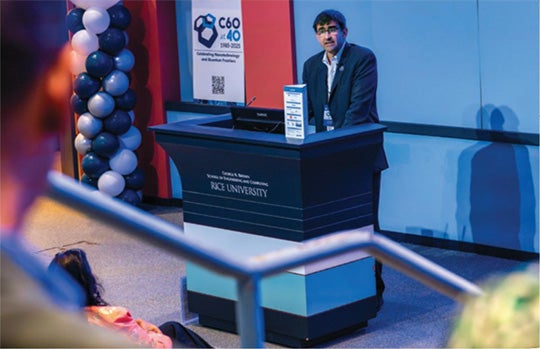
Thomas Killian, dean of the Wiess School of Natural Sciences, noted while observing the 40th anniversary of the buckyball that the Wiess School of Natural Sciences is also celebrating its 50th anniversary this year. Anniversaries, he told the crowd, are important opportunities to reflect on past achievements while looking forward to future breakthroughs.
“Throughout this golden anniversary year, we’ve been celebrating the milestone achievements in natural sciences that have shaped scientific exploration not only at Rice but around the world,” Killian said. “And of course, C₆₀ looms large in that history.”
Today, the legacies of Smalley and Curl continue through the eponymous Smalley-Curl Institute at Rice, which is headed by Junichiro Kono, the Karl F. Hasselmann Chair in Engineering.
“We are witnessing an extraordinary convergence of fields, from quantum materials and photonics to nanotechnology and data science,” Kono said. “At Rice, we are uniquely positioned to lead this transformation. The Smalley-Curl Institute continues to stand at the forefront of nanoscience and quantum engineering.”
Speaker sessions on day two of the event focused on topics such as advancements in nanoparticles and photonics, led by Matteo Pasquali, director of Rice’s Carbon Hub, and discussions on quantum physics led by Kaden Hazzard and other speakers to highlight how C₆₀ laid the foundation for atomic-scale research. Emilia Morosan, director of the Rice Center for Quantum Materials, hosted presentations explaining how today’s discoveries in materials science echo the pioneering spirit of the groundbreaking work done in 1985.
Kono encouraged students and researchers who want to shape the next generation of technologies, including resilient quantum devices and sustainable materials, to continue making themselves at home at Rice — the home of nanotech.
“Rice is the place to be,” Kono said. “The same spirit of curiosity, collaboration and bold thinking that once inspired the discovery of C₆₀ is still alive here today, and honestly, I have never been more excited about what’s ahead.”
After the Buckyball
Although the Rice Quantum Institute was founded as the university’s first interdisciplinary institute in 1979 by Robert Curl, Richard Smalley, Frank Tittel and other faculty members, it was the discovery of C₆₀ which instantly made Rice a global hub for nanoscience. Smalley leaned hard into the field and became a public advocate for nanotech, coining the phrase “the next industrial revolution.”
Smalley used his platform to lobby Washington, pushing nanotech funding onto the national agenda. His testimony before Congress in the late 1990s directly influenced the National Nanotechnology Initiative (2000), which poured billions into the field.
Smalley himself also founded the Center for Nanoscale Science and Technology at Rice in 1993 — renamed to honor him posthumously in 2005 — which became one of the first major U.S. centers dedicated to nano research. And in 2015, the Richard E. Smalley Institute for Nanoscale Science and Technology and the Rice Quantum Institute were merged to form a new entity: the Smalley-Curl Institute.
By this time, Rice was already known worldwide as the home of nanotech, and had become a magnet for funding, faculty recruitment and graduate students eager to become pioneers themselves. This is because although it was C₆₀ which was first discovered here, Rice researchers were also early adopters in the areas of graphene and carbon nanotubes.
In 2023, the SCI began a renewal campaign, under the leadership of former director Naomi Halas, adding staff and programs with a mission to:
- Support faculty across the university in collaborating on Thematic Working Interest Groups, which have led to a higher volume of large grant proposals and other leadership efforts
- Increase support for the Rice Quantum Initiative and the Rice Center for Quantum Materials.
- Continue the momentum in the Applied Physics Program of graduate studies, which is one of the world’s leading programs of its kind.
- Establish and strengthen the relationships with agencies, institutions, industry and universities that will lead toward groundbreaking research and meaningful innovation.
- Support continued leadership in nanoscale and quantum research and technology.
At the beginning of 2024, Rice named Junichiro Kono Director of the Smalley-Curl Institute, continuing the tradition of strong leadership by research-active leaders taking the institute to new levels of excellence. Kono is a world leader in studies of light-matter interactions and nanomaterials and a longtime champion of global student and scholar exchange between the U.S. and Japan, Taiwan, China, Singapore, and France.
Today Rice is an international hub for quantum materials research: superconductors, exotic topological states, and novel 2D materials beyond graphene. Over 40 faculty in physics, chemistry, bioengineering, mechanical engineering, materials science, and electrical and computer engineering still leverage the legacy of Smalley’s work, including Pulickel Ajayan (nanotubes, 2D materials), Boris Yakobson (computational nanoscience) and Jun Lou (mechanical behavior of nanostructures).
And thanks to Rice’s Department of Bioengineering and its proximity to the Texas Medical Center, Rice has also pushed into biomedical nanotech, where buckyballs and nanotubes have inspired targeted drug delivery, cancer therapies and biosensors.
Fullerene research also opened the door to solar cells and energy storage, making Rice a leader in sustainable nanomaterials for batteries, clean fuels and environmental remediation. Projects currently underway at the university include nano-enabled carbon capture, PFAS cleanup and water purification membranes.