
BY KATHARINE SHILCUTT
A new book from historians Alexander Byrd and Caleb McDaniel engages questions specific to Rice's history with slavery and desegregation, and reflects not only new findings — including a never-before-examined 1868 will left by William Marsh Rice — but a deeper rethinking of how history is researched, interpreted and understood.
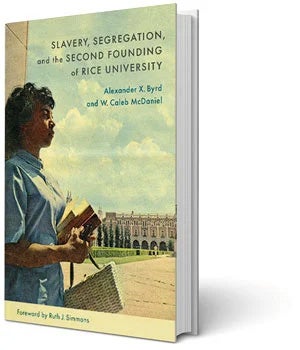
Although Rice did not open until 1912, it was connected to the history of slavery through the life of its founder and namesake, William Marsh Rice, whose fortune was deeply intertwined with the enslavement of Black people. And in 2019, then-president David Leebron commissioned a Task Force on Slavery, Segregation, and Racial Injustice helmed by Byrd and McDaniel to examine this history in greater depth. In 2023, the task force released its final report and recommendations, and in 2025 the historians published a companion book — “Slavery, Segregation, and the Second Founding of Rice University” — based on the in-depth research they’d conducted over the previous six years.
“We started with the goal of bringing the research reports from the task force together into one volume,” said McDaniel, Rice’s Mary Gibbs Jones Professor of Humanities, a professor of history and editor of the Journal of Southern History.
But as the historians worked to synthesize the material, new questions and sources emerged.
Why do historians find new things? Sometimes it is because collections that weren't accessible become accessible, but you also find new things because you go back to old sources with new questions. —Caleb McDaniel.
“Why do historians find new things? Sometimes it is because collections that weren't accessible become accessible, but you also find new things because you go back to old sources with new questions,” said McDaniel.
Byrd and McDaniel are no strangers to the amount of revision and rethinking necessary for historians to put together a narrative of their findings. McDaniel’s book “Sweet Taste of Liberty: A True Story of Slavery and Restitution in America” won the Pulitzer Prize for History. Byrd’s book “Captives and Voyagers: Black Migrants across the Eighteenth-Century British Atlantic World” received the Wesley-Logan Prize.
For this new book, they worked together to sift through archival material related to the work of the task force, including some sources that have only recently become easily accessible to scholars. Collections at the Houston Heritage Society and the Houston Public Library, for instance, existed for years but were not fully processed or digitized. But during the COVID-19 pandemic, they were digitized to support the task force’s work. Many of those materials, McDaniel said, “related directly to the Civil War era.”
And even within Rice’s own archives, materials long overlooked took on new significance. The historians found business ledgers from the antebellum and early Civil War periods that “for a long time… lived in the basement of Lovett Hall and then the Allen Center in a vault” before they were transferred to the Woodson Research Center at Fondren Library around 1994. Descriptions of these ledgers characterized them as routine grocery store accounts, but closer examination revealed far more.
“These ledgers include mention of enslaved people and relationships between cotton plantations and William Marsh Rice,” McDaniel said.
Such discoveries are not accidental, but methodological, said Byrd, Rice’s Vice Provost for the Office of Access and Institutional Excellence and an associate professor of history. He pointed to what he described as an older — but still vital — historical principle.
“There’s this notion of comprehensiveness: you’ve got to read everything about the thing,” Byrd said. That approach, Byrd argued, stands in contrast to more modern reliance on keyword searches or how an archival document is described in simple terms. “These examples speak to that. The archives clearly say it's ‘a grocery book,’ but you gotta turn every page.”
That method also led to one of the most significant findings in the new book: the discovery of an 1868 will drafted by William Marsh Rice.
“Earlier histories have always said that Rice started thinking about founding an institute in the 1880s, and the earliest will we had was from 1882” McDaniel said. But while revisiting the Woodson Research Center archives to chase down a footnote, McDaniel stumbled upon an 1868 will that fundamentally reshapes the university’s origin story.
In that document, Rice declared his intention to fund “a school for the poor white children of Harris County” and named a board of trustees which included individuals who later served on the first board of the Rice Institute.
There’s this notion of comprehensiveness: you’ve got to read everything about the thing, These examples speak to that. The archives clearly say it's ‘a grocery book,’ but you gotta turn every page —Alexander Byrd
“This changes our understanding of the earliest moment where Rice was thinking about founding a school in Houston,” McDaniel said. “The origin story starts not in the north in the 1880s but in Texas, in the Reconstruction period immediately after the Civil War.”
While the 1868 will is a major addition, McDaniel stresses that it is only one example of new material throughout the book that was not included in the task force reports. And these findings are inseparable from the task force’s recommendations, which Byrd describes as the most ongoing aspect of the work.
“To give this work justice, one must pay as much attention to the recommendations of the task force as one does to the methods and the findings that led to them,” Byrd said. “They come out of good history.”
Both the task force and book exist within a much larger scholarly landscape, the historians also pointed out — one that has developed over the past 25 years as universities have examined their own histories.
“This should be seen not as the final word,” McDaniel said, “but as joining that cross-generational conversation.”