
BY BRANDI SMITH
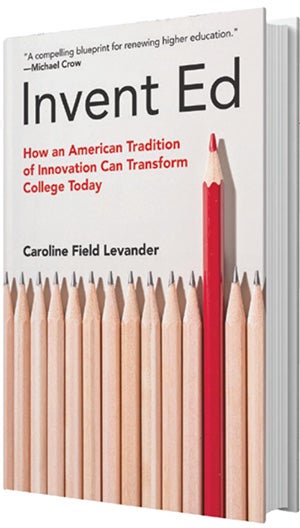
As colleges, universities and policymakers grapple with how to remain relevant in an era of rapid technological change, reassess the value of a degree and reinvent what higher education means for today’s learners, Caroline Levander is uniquely positioned to offer authoritative insight. Levander serves as vice president for global strategy and the Carlson Professor in the Humanities at Rice, where she leads development of new global hubs, online learning and strategic partnerships. She is also the author of the new book “Invent Ed: How an American Tradition of Innovation Can Transform College Today.”
What’s missing in the public conversation is a clear explanation of how universities actually generate creativity and discovery. — Caroline Levander
There are countless books critiquing higher education. What gap did you see that “Invent Ed” needed to fill?
I wrote “Invent Ed” because there are two dominant conversations about higher education happening right now. One is led by people outside the academy who don’t really understand how universities work today. The other is led by former administrators writing mainly for the industry. There’s a real gap for the average American to understand why universities matter and why they are such an important part of our national culture and economy.

What’s missing in the public conversation is a clear explanation of how universities actually generate creativity and discovery. American higher education did not become globally dominant by accident. It did so because it cultivated an inventive spirit: a willingness to experiment, to recombine ideas and to see knowledge as something dynamic rather than fixed. I wanted to remind readers of that history and show how it can guide us forward.
You argue that universities have drifted from their inventive roots. What do you mean by that and what have we lost?
Creativity is putting existing concepts, ideas and tools into new combinations. Universities are the richest archive and laboratory for those ideas, which makes them the natural home for creative discovery.
Over time, though, we have allowed a culture of credential-getting to overshadow a culture of invention. Students are more risk-averse than they were in prior decades. They are focused on grades, rankings and outcomes in ways that often prevent them from taking intellectual risks. That is deeply detrimental to long-term success because students are not taking full advantage of the resources universities offer to stimulate discovery.
When education becomes a zero-sum game centered on transcripts and performance, anxiety flourishes. A creative mindset, which involves playing with tools, experimenting, combining ideas, is an engaged and optimistic mindset. It builds capability over time. If we want students to thrive in unpredictable workplaces and societies, we have to reward exploration, not just efficiency.
How should universities respond to AI and rising skepticism about the value of a college degree?
AI is often framed as something happening to universities, but that misses the point. Universities are shaping AI even as they adapt to it. Many of the discoveries behind the AI revolution happened in university research labs. That shared partnership of discovery is critical moving forward.
We have a responsibility to teach students how to use AI ethically and responsibly. Students need to be in the driver’s seat because the ability to direct and manage these tools is a major advantage in the marketplace. At the same time, we need to communicate more clearly what universities contribute to society. American universities are engines of discovery and new industry creation. That has driven our global prominence for decades. The more we lose sight of that, the more vulnerable we become as a country.
Why did you choose MIT Press as the publisher for “Invent Ed”?
In addition to being one of the largest and most distinguished university presses in the world, MIT Press is the leading publisher of books and journals at the intersection of science, technology, art, social science, and design. And they are known for their intellectual daring, scholarly standards, interdisciplinary focus and distinctive design.
Because their mission is to advance knowledge in science, technology and the arts that best serve the nation and the world in the 21st century, the Press is the perfect home for “Invent Ed,” which shows how American universities can become powerful contributors to the public good.